Large Loss and Catastrophic Response in Midland
Large loss and catastrophic response in Midland and surrounding areas. Insurance billing accepted. Call (432) 847-4704.
Multi-million dollar loss on your hands? A burst main on the third floor of a commercial building, a sewage backup running through forty apartment units, a storm that pushes water across an entire warehouse floor, none of that gets fixed with one truck and two technicians. Large loss and catastrophic response is a different scale of problem: multiple affected structures or floors, dozens of stakeholders, and a timeline where every day of standing water adds cost. ACS Enterprise handles the water damage and cleanup side of these events for commercial, multi-family, and industrial properties across the Midland area, bringing in the crews, pumps, and drying equipment a loss of this size actually requires.
What large loss and catastrophic response actually involves
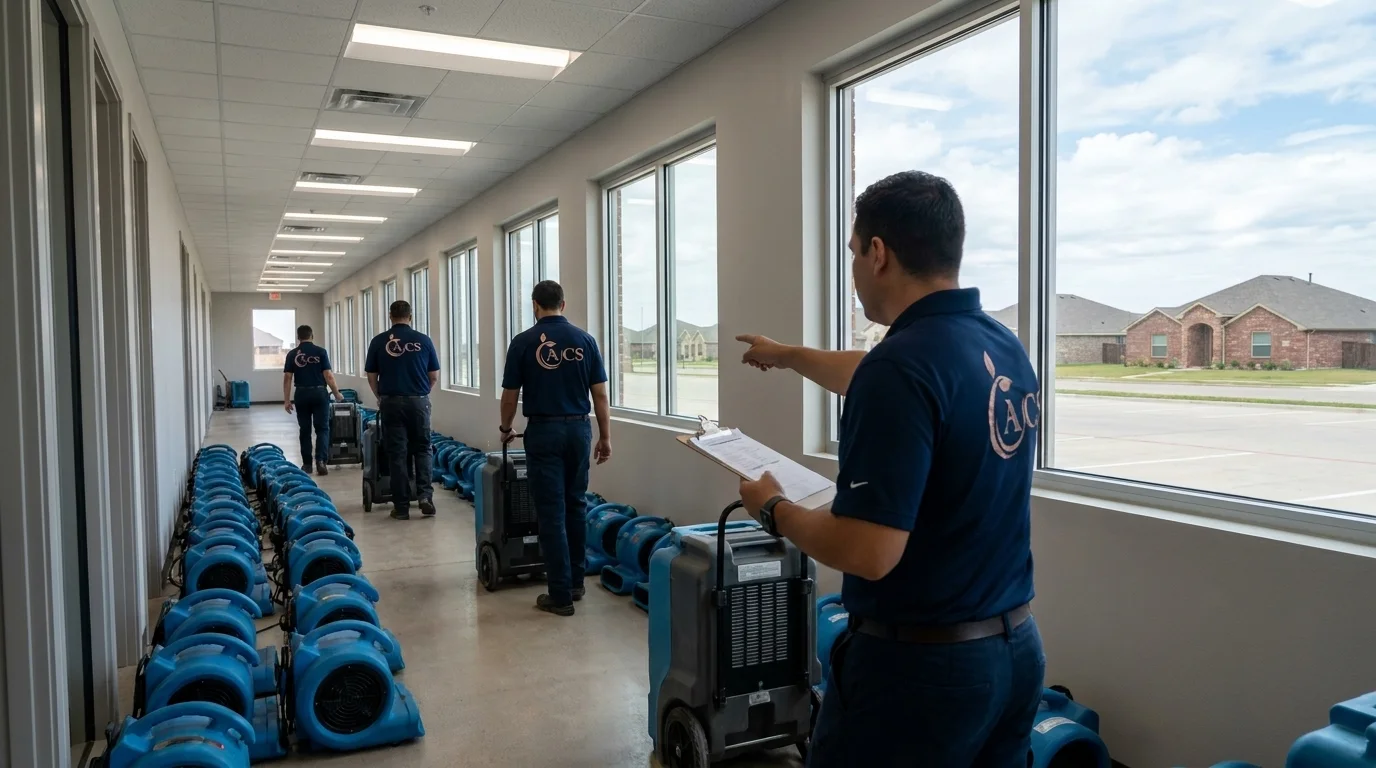
A catastrophic loss isn’t a bigger version of a residential water call, it’s a different operating model. Instead of one crew working one source of water, you’re coordinating truck-mounted extraction units, multiple submersible pumps, and bank after bank of desiccant and refrigerant dehumidifiers running simultaneously across different zones of the same property. Affected square footage is measured in tens of thousands of square feet, not rooms. The building may have multiple owners, a property management company, tenants who need to stay operational, and an insurance claim large enough that a dedicated large loss adjuster is assigned before the water has even stopped moving. Timelines stretch from days into weeks depending on how much structure got wet and how deep the water traveled into wall cavities, subfloors, and mechanical spaces. ACS Enterprise’s role on these jobs is water extraction, structural drying, and sewage or storm cleanup at the scale the loss demands, documented in a way that holds up under adjuster review.
Our process
- Site-wide damage assessment. Before equipment gets staged, the affected structure gets walked floor by floor, moisture mapped by zone, and the scope of wet materials documented in writing so the project has a baseline everyone is working from.
- Mobilization at scale. Extraction equipment, pumps, and dehumidification capacity get sized to the actual square footage affected, not a standard residential setup, with crews deployed to run multiple zones in parallel instead of sequentially.
- Zone-by-zone drying and monitoring. Each affected area gets its own moisture log, with psychrometric readings tracked and recorded per zone and dried per the IICRC S500 standard for structural drying, so progress on one floor doesn’t get lost in the noise of the whole project.
- Adjuster and property management coordination. Large loss adjusters work from documentation, not assumptions. Daily or weekly progress reporting, photo logs, and moisture data get compiled so the claim moves without repeated site visits.
- Final verification and handoff. Once structural moisture readings confirm the affected materials are dry, the water-side scope closes out, and if the loss requires mold evaluation or rebuild, that handoff to the right specialist happens on ACS’s recommendation rather than being absorbed into the water scope.
What separates a good large loss response from a bad one
The most common mistake on catastrophic jobs is treating them as a dozen small losses instead of one coordinated project. That shows up as inconsistent moisture logs, equipment pulled off a drying zone too early because nobody tracked it separately, and documentation that doesn’t match floor to floor. Adjusters reviewing large loss claims are looking for exactly that consistency: dated moisture readings per room or zone, photos that correspond to the readings, and a scope of work that was written before the drying started rather than reconstructed afterward. Another frequent miss is underestimating how far water travels through a slab or wall assembly in a commercial structure. A ground floor that reads dry at the surface can still have saturated insulation or subfloor two zones away from the original source, and a rushed response pulls equipment before that secondary saturation is addressed. Response speed matters too: the gap between a storm or pipe failure and equipment hitting the floor is often the single biggest driver of whether a loss stays a water job or turns into a much larger secondary problem.
What does large loss and catastrophic response cost?
Costs on catastrophic losses scale with affected square footage, number of floors or units involved, and how long water sat before mitigation started. Every loss is different, and ACS Enterprise provides a written scope of work before mobilization so the property owner and adjuster are working from the same numbers. Most commercial and multi-family property insurance policies cover water mitigation costs for a covered loss, though coverage for any resulting mold or rebuild work depends on the specific policy and is handled separately from the water scope.
| Scenario | Typical range |
|---|---|
| Single-floor commercial water loss, under 5,000 sq ft | $8,000 - $25,000 |
| Multi-unit apartment building, partial flood affecting several units | $25,000 - $80,000 |
| Sewage backup affecting multiple floors or units | $30,000 - $100,000+ |
| Warehouse or industrial facility, large-scale water intrusion | $50,000 - $200,000+ |
| Storm-driven flooding across a multi-building commercial property | $100,000 - $500,000+ |
Seasonal & regional considerations
West Texas thunderstorms can drop a significant amount of rain in a short window, and flat terrain combined with clay and caliche soils around Midland means water pools against commercial foundations and in parking structures faster than it drains. Aging plumbing in older commercial buildings and shifting clay soils are a common source of slab leaks that go unnoticed until they’ve saturated a large footprint. On the upside, the region’s low humidity speeds structural drying once equipment is running, which helps keep large loss timelines shorter than they’d run in a more humid climate.
Service area
ACS Enterprise responds to large loss and catastrophic water events across Midland and the surrounding Permian Basin, including commercial and multi-family properties throughout the region.
If you’re managing a loss that’s bigger than a single unit or a single room, call (432) 847-4704 to start a site assessment and get a written scope of work moving before the claim timeline works against you.
Frequently Asked Questions
Does insurance cover large loss and catastrophic water damage response?
How is a large loss response different from a standard water damage call?
How does ACS coordinate with large loss adjusters and property managers?
Does ACS Enterprise handle the mold or rebuild side of a large catastrophic loss?
How long does drying take on a multi-floor commercial or multi-unit loss?
Looking for the best large loss and catastrophic response company in Midland?
ACS Enterprise provides large loss and catastrophic response in Midland, TX and the surrounding area, and has served local property owners since 2019. Customers rate us 5.0 out of 5 stars across 367 Google reviews. We answer calls 24/7 — call (432) 847-4704 for immediate help.
Need Large Loss and Catastrophic Response now?
We respond 24/7 across Midland and surrounding TX cities.
Related Coverage
- Our Restoration Services
- Commercial Restoration in Midland
- Industrial Restoration in Midland
- Emergency Water Damage Restoration in Midland
- Contact ACS Enterprise
- Restoration Services in Andrews
- Restoration Services in Big Lake
- Restoration Services in Big Spring
- Restoration Services in Crane
- Restoration Services in Garden City
- Restoration Services in Gardendale
- Restoration Services in Goldsmith
- Restoration Services in Greenwood
- Restoration Services in Imperial
- Restoration Services in McCamey
- Restoration Services in Monahans
- Restoration Services in Odessa