
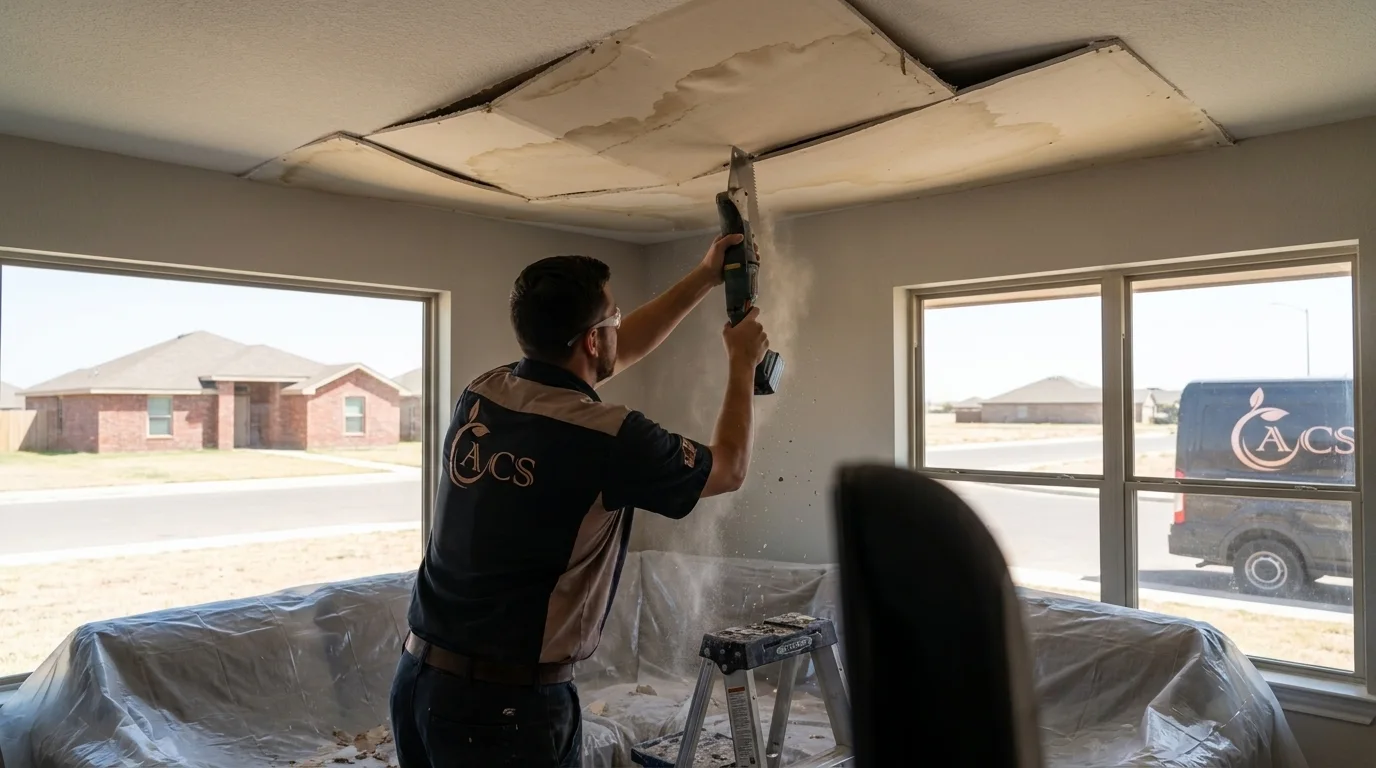
Emergency Ceiling Water Damage Repair in Midland
Emergency ceiling water damage repair in Midland and surrounding areas. Insurance billing accepted. Call (432) 847-4704.
Water coming through your ceiling right now? Call ACS Enterprise at (432) 847-4704. A brown ring spreading across drywall or a soft, sagging patch overhead means water has already pooled above the ceiling plane, and the longer it sits, the more likely the substrate fails. We handle the water damage side: finding the source, pulling the water out, and drying the structure down. Call now for emergency service and we’ll get a technician scheduled to assess the leak before it spreads further into the framing or adjoining rooms.
What ceiling water damage repair actually involves
A leaking ceiling is rarely just a ceiling problem. Water that stains drywall has usually traveled through insulation, across joists, or along a top plate before it ever showed up as a spot on the paint. Our work starts above the visible damage: locating where the water is entering (a roof penetration, a slipped supply line, an AC condensate pan, a second-floor bathroom) and stopping active intrusion before drying begins. From there, we’re dealing with saturated insulation that’s lost its R-value, drywall that’s delaminating from the paper backing, and sometimes a sagging ceiling that’s carrying several gallons of trapped water in the cavity above it. Equipment on a typical ceiling job includes a moisture meter to map how far the water traveled, a borescope or small access cut to inspect the cavity without blind demo, air movers positioned to dry the joist bay, and a dehumidifier sized to the affected rooms. Drying timelines vary with the ceiling assembly (plaster holds moisture longer than modern drywall) and whether insulation above the ceiling needs to be removed. What we don’t do is patch, texture, and repaint the ceiling once it’s dry. That finish work goes to a general contractor or reconstruction crew; we’ll tell you plainly where our scope ends so you know who to call next.
Our process
- Source identification. Before any drying starts, we trace the leak, whether it’s roofing, plumbing, or an HVAC line, because drying a ceiling without stopping the source just means doing it twice.
- Moisture mapping. We use a meter to find the actual boundary of wet material. Ceiling stains almost always understate how far water has traveled laterally along joists.
- Controlled access and extraction. If water is pooled in the ceiling cavity, we cut a controlled access point to drain it safely rather than letting a sagging section fail on its own, which is both a mess and a fall hazard.
- Structural drying. Air movers and dehumidifiers run on the affected cavity and room, dried in line with the IICRC S500 standard, with daily moisture readings until the framing and remaining drywall read dry.
- Documentation and handoff. We photograph and log every stage for your insurance file and point you to a reconstruction contractor for drywall replacement, texture matching, and paint.
What separates a good ceiling water damage response from a bad one
The most common shortcut is drying the visible stain and skipping the cavity behind it. A ceiling can look dry to the touch on day two while the joists and insulation above it stay saturated for a week, which is exactly the setup for a secondary problem down the line. A careful operator pulls insulation that’s lost its loft rather than drying it in place, because wet fiberglass or cellulose rarely recovers its insulating value even after it’s technically dry. Adjusters reviewing a ceiling claim also look for documented moisture readings over time, not just a before-and-after photo, since that log is what proves the structure was actually dried rather than just dried enough to look fine. Another mistake we see: patching drywall before the framing underneath has been verified dry, which traps moisture and invites exactly the kind of hidden problem a homeowner was trying to avoid in the first place.
What does ceiling water damage repair cost?
Costs depend on how far the water traveled, whether insulation needs removal, and how many rooms are affected below the leak. Every loss is different, which is why ACS Enterprise provides a written scope before any work begins. Homeowners insurance typically covers sudden and accidental water damage, like a burst supply line or a failed water heater, but it generally excludes long-term leaks tied to deferred maintenance, so it’s worth reviewing your policy language before assuming full coverage.
| Scenario | Typical range |
|---|---|
| Single ceiling stain, no sagging, early catch | $350 - $900 |
| Sagging ceiling section with cavity drainage | $800 - $2,200 |
| Full room drying with insulation removal | $1,800 - $4,000 |
| Multi-room damage from a second-floor leak | $3,500 - $8,500 |
| Plaster ceiling, older home construction | $2,000 - $5,500 |
Seasonal & regional considerations
In Midland’s climate, ceiling leaks often trace back to HVAC condensate lines rather than roofing, since attic-mounted systems running hard through long, hot summers can clog a drain line and back up into a ceiling cavity fast. Winter brings the opposite risk: overnight freezes followed by a quick warm-up can crack a supply line in an attic or exterior wall, and the leak doesn’t show up on the ceiling below until the thaw. West Texas wind events can also drive rain under shingles or flashing, so a ceiling stain that appears after a storm is worth checking against recent weather, not just assumed to be a plumbing issue.
Service area
ACS Enterprise handles ceiling water damage repair throughout Midland and the surrounding Permian Basin communities, including Odessa, Big Spring, and Andrews.
If water is actively coming through your ceiling or you’ve found a soft, sagging spot overhead, schedule your moisture assessment with ACS Enterprise at (432) 847-4704 before the drywall gives way.
Services We Handle
- Roof Leak Water Damage
Frequently Asked Questions
Does homeowners insurance cover ceiling water damage repair?
How can I tell if a ceiling leak is from plumbing, roofing, or HVAC condensation?
Is a sagging ceiling a sign the drywall needs to come down right away?
What happens to the insulation above a leaking ceiling?
Can ACS Enterprise repair the ceiling drywall after the water damage work is done, or just the water portion?
Looking for the best ceiling water damage repair company in Midland?
ACS Enterprise provides ceiling water damage repair in Midland, TX and the surrounding area, and has served local property owners since 2019. Customers rate us 5.0 out of 5 stars across 367 Google reviews. We answer calls 24/7 — call (432) 847-4704 for immediate help.
Need Ceiling Water Damage Repair now?
We respond 24/7 across Midland and surrounding TX cities.
Related Coverage
- Our Restoration Services
- Emergency Water Damage Restoration in Midland
- Water Leak Detection in Midland
- Emergency Storm Damage Restoration in Midland
- Contact ACS Enterprise
- Restoration Services in Andrews
- Restoration Services in Big Lake
- Restoration Services in Big Spring
- Restoration Services in Crane
- Restoration Services in Garden City
- Restoration Services in Gardendale
- Restoration Services in Goldsmith
- Restoration Services in Greenwood
- Restoration Services in Imperial
- Restoration Services in McCamey
- Restoration Services in Monahans
- Restoration Services in Odessa